 SumMeld
How to play Sumbreak
Sumbreak is a puzzle where you merge numbers. Learn which tiles can combine, how wildcards work and why the landing square matters.
The goal of Sumbreak
You start with a grid of numbered tiles, sometimes with empty cells or wildcards. Each legal merge consumes two occupied cells and leaves one numbered tile. Keep going until that last tile is the only one on the board. A full board with nine tiles therefore takes eight successful merges, even if you take time to undo moves and try a different route.
Open the official LinkedIn Sumbreak game to see the starting position. You can drag or swipe one tile toward its neighbor, or select the starting tile and then the destination. The first square clears, the result goes in the second square, and every other tile stays where it was.
Merge two equal neighbors
Ordinary number tiles can merge when they have the same value and share an edge. The values are added and the result occupies the selected destination. In the example below, the left 2 moves into the right 2. Reversing the direction would still make 4, but the 4 would appear in the left cell instead.
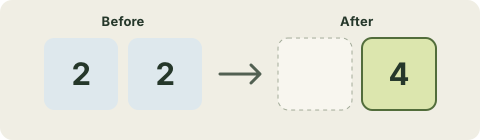
Look for neighbors on the same row or column. A tile across an empty square is out of reach, and two tiles that touch only at a corner cannot merge. If you are checking a solution, read each move as an ordered pair of squares, since the same numbers can be present in more than one part of the grid.
Use addition and multiplication wildcards
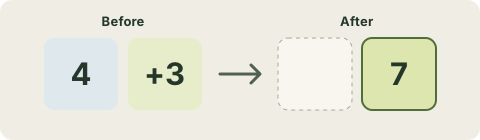
A wildcard shows an operation instead of an ordinary number. It pairs with a neighboring number and applies that operation to it. For addition, use the amount shown on the tile. In the example below, a 4 merges into a +3 wildcard. The destination becomes an ordinary 7, ready to merge again if it has an adjacent match.
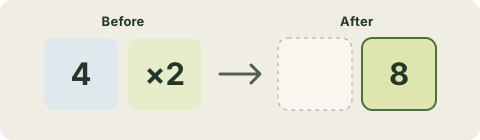
A multiplication wildcard multiplies the number by its displayed factor. In this example the factor is 2, so the 4 becomes 8. You can also merge the wildcard into the number tile. Use that direction if the original number’s square puts the 8 next to a better follow-up.
Two wildcards cannot merge. A move must leave a positive whole number within the game’s supported range. Since the wildcard is consumed, check which number will give it the most useful result before committing. Sometimes the best use is a later merge, after the smaller tiles have combined.
Choose the destination before moving
Try looking one move ahead. When either tile can be the destination, compare the neighbors of both squares. Choose the square that gives the new number a useful match.
When several moves look possible, begin with an area where the next partner is clear. Check the edges and corners before clearing the tiles nearby. A tile can be stranded if the squares that connect it to the rest of the board are emptied too early. Ordinary tiles cannot move into those gaps to reconnect the board.
Sumbreak vs. 2048: What’s the Difference?
Both games let two matching numbers combine into a larger tile. In Sumbreak, you choose which pair to merge and which square keeps the result. In classic 2048, you choose a direction for the whole board.
| Rule | Sumbreak | 2048 |
|---|---|---|
| Movement | Merge one adjacent pair into the target square. | Slide all movable tiles in one direction. |
| After a move | The source square stays empty. No new tiles appear. | A new tile appears after a move that changes the board. |
| Goal | Finish with one number on the board. | Create a 2048 tile. |
Take a Sumbreak row of 2, 2, 4. Merge the left 2 into the middle and the new 4 lands next to the original 4. Merge the middle 2 to the left and an empty square separates the two 4s. A later swipe can’t close that gap.
Try an Easy 3×3 Sumbreak puzzle and see how choosing the landing square sets up the next merge.
Looking for another grid puzzle? Compare games like Sumbreak by how they use numbers, shapes, and paths.
Recover from a dead end
When the board still has several tiles and none can merge, go back to the last move that opened up a gap or left a tile isolated. Try reversing the landing direction and check the new neighbors before moving on. If several guesses came after the mistake, Reset gives you the starting board again.
If you want outside help, use the Sumbreak answer and hints page. Match the date and initial grid first. A hint can confirm a single move, and the dated walkthrough shows the board after each merge so you can find the first place where your sequence diverged.
Sumbreak rules FAQ
Can I merge diagonally?
No. The tiles must share a side, so they can be directly above, below, to the left or to the right of each other. Tiles that only touch at a corner cannot merge.
Can I slide a tile into an empty cell?
No. A move needs two occupied cells that can merge. Empty cells stay empty, and gaps cannot be crossed. This is why the landing square matters even when both directions give the same arithmetic result.
Can I merge two different numbers?
Two ordinary number tiles must match. A wildcard can combine with a neighboring number and apply the operation shown on the wildcard. For instance, a 4 and a +3 wildcard can merge, while an ordinary 4 and an ordinary 3 cannot.
Does it matter which tile I select first?
Yes. The first tile disappears, and the new value goes in the second tile’s cell. Choose the destination by looking at what the result can merge with next.
Can two wildcards merge with each other?
No. Every wildcard merge needs one number tile. Once the operation has been applied, the tile left on the board is an ordinary number.
How do hints, Undo and Reset work?
A hint can show a next move from a solvable board or restore an earlier solvable position if you have taken a bad route. Undo reverses a move. Reset restores the starting board so you can try a different sequence.
Is the final number always the sum of the starting tiles?
It is on a number-only board. A wildcard can change the total, and the order of wildcard operations can affect the final result. A board is solved when one ordinary numbered tile remains.